Maricha

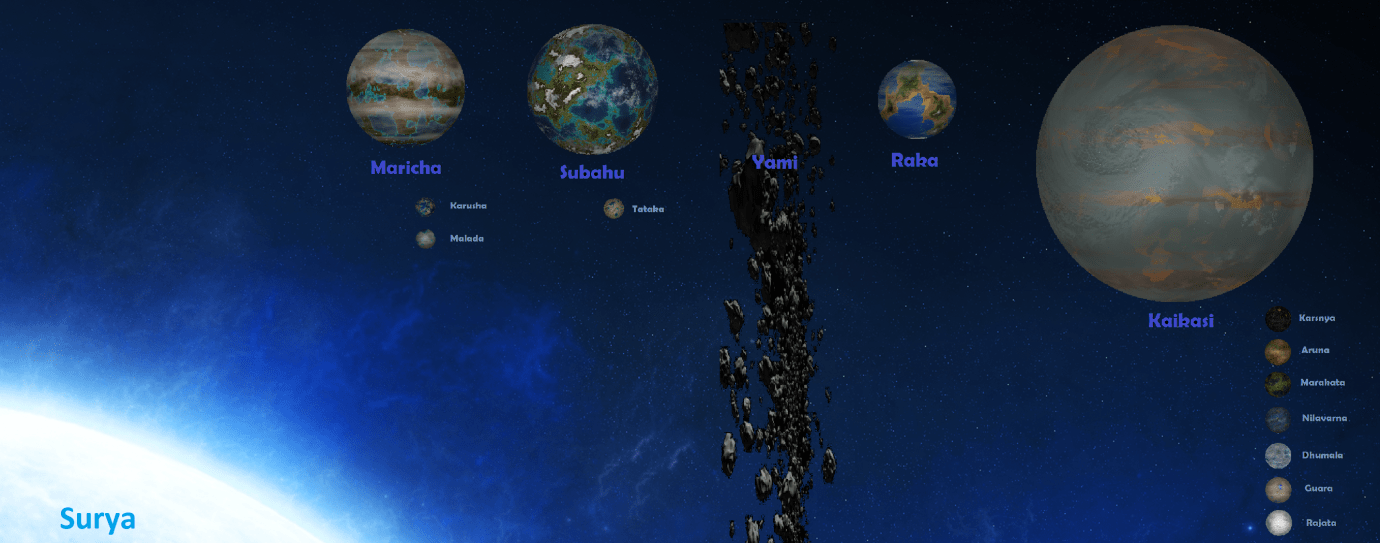
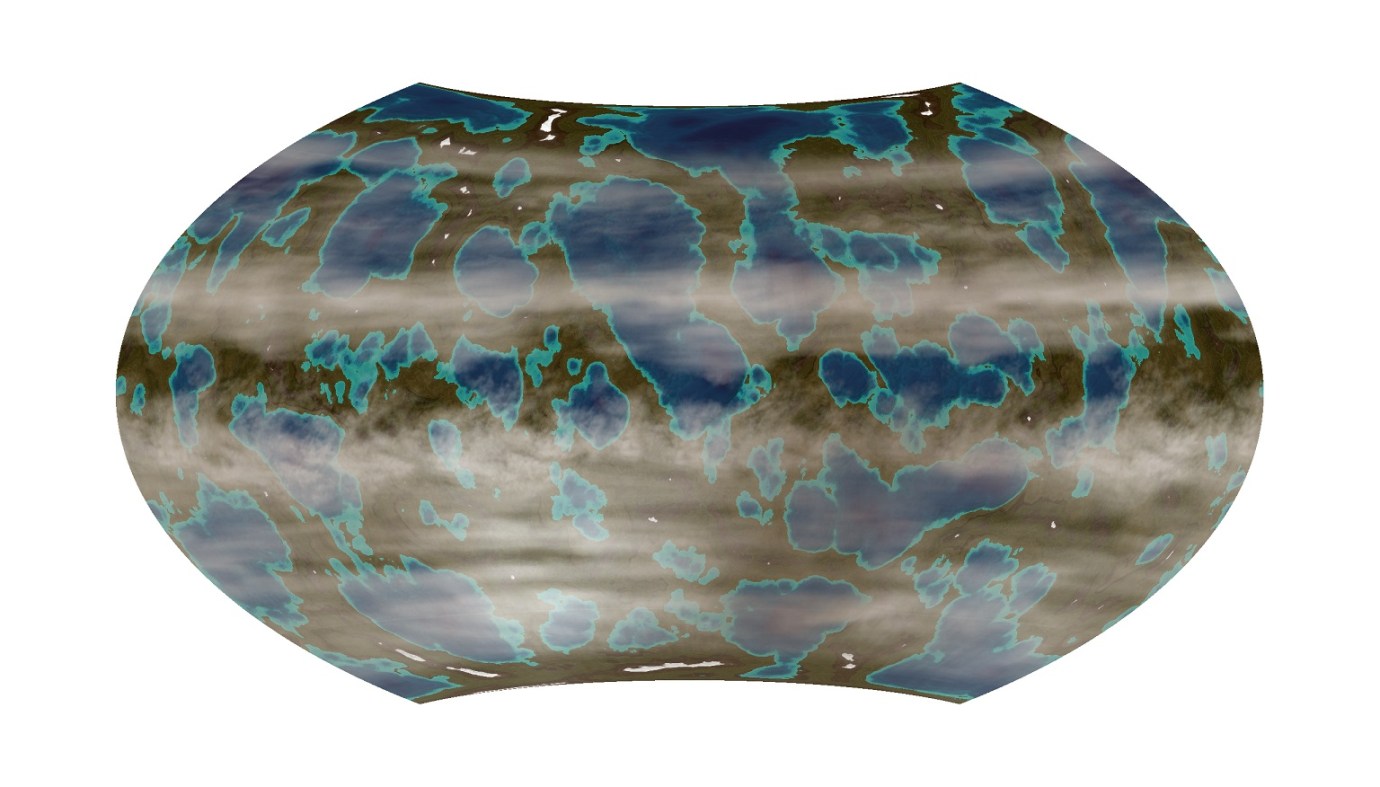
Maricha is the closest world to Surya, the primary sun of the Mitra system.

Mean Orbital Distance:150 million km
Days to Orbit:420
Mean Radius:7,944 km
Surface Area:792 million km2, Landmass 491 million km2
Base Temperature:30° C
Seasonal Variation:38° C (High), 24° C (Low)
Average Annual Precipitation:75 cm
Significant Imports:Machinery (2.5 MMT), Medicines (2 MMT)
Significant Exports:Organics (14 MMT), Consumer Items (5 MMT)

A colony world of the Janya, inhabited by the natives to the Surya system, the Kravyad. Maricha is home to a temperate climate, and an agriculture based economy. To the Kravyad, this world is known as Taise.

Maricha is a Dominion of the Solar Kingdom, and its capital is Pak Sacara. Major cities include Bal Ivarda, Karaja, Ksauri, Murdhan, Naka, Nikrandati, Rahi Karoti, Sakhila, Sar Agata, Sauv Ira, and Zil Ajit. Two moons orbit high above Maricha: Malada and Karusha.

Primitive Tech and Solar Travel

The Primitive Tech equivalents of Radium Drive and Empyrean Sail are Nuclear Thermal Propulsion and Nuclear Thermal Propulsion (redundancy intentional).

Cutting Edge Primitive Tech (CEPT) uses alchemically enriched “clean” uranium fuels. Currently, production is only really implemented at the fighter / shuttle scale (less than 5000 cubic meters displacement), with rated flight times of less than 12 hours before refueling is necessary. Pre-Arrival Kravyad spaceflight used much less efficient fuel (that was additionally much more toxic from a radiation-poisoning perspective), but was used for surface to orbit, and orbit to orbit spacecraft. Even if one of those vehicles were recovered and rehabilitated today (or built by renegade production facilities), performance would only approximate 1/10th that of Empyrean Sail – so a Maricha to Subahu orbit would take on the order of 60 – 100 days instead of the approximate week that the trip take by Empyrean Sail now, with fuel accounting for 90% or more of the vehicle mass.

CEPT designs allow for Andhaka or Outcaste pilots, and the transportation of significant numbers of travelers of either class. CEPT designs in larger scale craft likewise provide for the comfort and safety of those travelers on intrasolar journeys. While unscrupulous transportation concerns may be tempted to falsify the designation, a potential of a dozen Andhaka to destabilize flight control functions tend to keep vendors honest.

Solarship Design Features

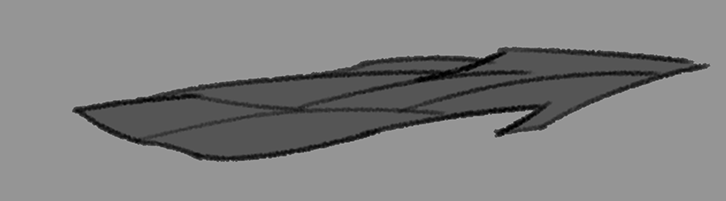
  • Solarships have a streamlined silhouette, like a rocket; or better, aquadynamic like a shark or a whale.
  • Solarship have long decks (interior) that run the length of the ship, perpendicular to the usual axis of thrust. So more like a ship than a skyscraper.
  • Solarships usually have a length to beam ratio somewhere between 6:1 to 8:1.
  • Solarships have two means of propulsion: a “Radium Drive” that is reactionless in that it doesn’t expel a propellant to impart motion (think directed anti-gravity, but *thirsty* anti-gravity), and “Empyrean Sails” that displace the majority of a ship’s mass and let it accelerate a fractional speed of light by dipping into subtle energy fields mostly emanated by the sun and gas-giant located in the system. Empyrean sails don’t help in in the solar void between stars, or when your acceleration becomes too much a fraction of your mass.
    1. Note that when there is a catastrophic Empyrean Sails failure, you don’t displace your full mass into realspace; you displace your remaining mass into the dark energy dimension the bulk of your mass was already hiding.
    2. There are Radium Drive Field modules that are external to the ship’s superstructure to generate and harness the inertial field moving the bulk of the ship around, Those modules are probably lit with strange energies, but are going to be reinforced to prevent damage, and to be solidly connected to the structure of the ship since the modules are where the thrust is being generated, and if they’re not solidly attached, they’ll tear themselves loose. The modules are probably as sleek and smooth as the ship itself.
    3. The Empyrean Sail itself is just going to look like a giant magnetic field ten times the size of the ship, catching photons. The Empyrean Sail projectors (or anchors), on the other hand, look roughly like spark plugs extending a significant fraction of the ship’s beam away from the hull. All things considered, they’re probably angled, and they probably extend and retract a fair amount.
  • Solarship weapon systems are kinetic, energetic, or rocket (but not torpedo) based, and all but the smallest are crewed by multiple gunner’s mates each. Given the streamlined nature of the hulls, the systems will be entirely or significantly withdrawn into the hull during normal operations.
  • Solarship design requires Technik to work.

Yami Belt – The Free City of Hanuruha

The Yami Belt is populated with military outposts, commercial outposts, and the casteless free people of the Janya.

These are the three primary political factions in the Yami Belt:

  • Provincial worlds are allied with the Solar Kingdom, and have political representation in Parliament
  • Independent worlds are the mostly Outcaste City-States that do business with the Kingdom, but are not a part of it
  • Outlaw worlds explicitly prohibit the Solar Navy from their aerospace, and correspondingly enjoy an attitude verging from apathy to hostility (depending on the circumstances).

Most legendary of the Outlaw worlds is the Free City of Hanuruha, and the pirate fleet that defends it.

The founding of the Free City of Hanuruha dates to the earliest construction of the Yami orbital colonies, approximately AY1350. In the half a millennium since then, it has been: lost, overrun, conquered, destroyed, infiltrated, annexed; and in at least one case existed in two separate geographical locations at the same time. Hanuruha endures.

Nominally a city-state of Liberty Utopians, Hanuruha has three defining characteristics (four, if you include “perennially overrun with pirates”).

  • The Hanuruha Authority secures the safety of the people and property located within the Dockyard, for a weekly fee. Solarships are constructed, repaired, upgraded, and resupplied in the Dockyards (with the Authority receiving a percentage of that action as well); frauds, cheats, and thieves who ply their arts in the Dockyard are subject to lethal punitive measures.
  • Products and services from across the system regardless of safety or legality are available at Market, with a singular exception: slavery of either the Janya or Kravyad peoples is prohibited (under pain of death for the slavers). The Hanuruha Authority intervenes only in the case of that singular infraction, otherwise the safety of products and consumers is loosely overseen by the private security of the most established merchants in Market.
  • Dispute resolution between the inhabitants (and visitors) of Hanuruha is the function of Circus. Blood-matches (theoretically non-lethal) and Death-matches (what it sounds like) are contracted by parties in dispute to Circus, who markets viewing, attendance, and gambling on the match. Blood-matches usually pay off to the victor, and Death-matches usually pay off to the beneficiaries of the side that loses.
Aniakchak-caldera_alaska

Setting: The MSN Parindra

Gen2 Light Cruiser Class.

Length: 150m; Beam: 25m; Displacement: 50K m3

Usual complement: 100 crew.


Control Deck (Zone 1)

Fair Cover. Dark. Battle Damaged.

Workstations for Captain, Engineer, Navigation, Weapons, Operations.

Exits to: Astrogation Deck (Zone 2)

There is a Kravyad work-crew here at the start of the scene.


Astrogation Deck (Zone 2)

Fair Cover. Dark. Breach to exterior.

Analog / Optical devices for determining location, plotting the orbital paths of the system, and charting a course between them.

Exits to: Control Deck (Zone 1), Quarters and Storage (Zone 3), Breach (Away).


Quarters and Storage (Zone 3)

Good Cover. Dark. Nooks and crannies.

Quarters for the usual crew of 100, plus emergency berthing for another 50. Galley and mess, elemental fonts for air and water.

Exits to: Astrogation Deck (Zone 2), Gunnery Deck (Zone 4)

There is a Kravyad work-crew here at the start of the scene.


Gunnery Deck (Zone 4)

Fair Cover. Dark. Disassembled Naval Scale Weapon Assemblies.

Weapons, Ammunition, and gunnery stations for the ship’s assortment of tactical (weapon) systems.

Exits to: Quarters and Storage (Zone 3), Hangar and Airlock Deck (Zone 5)

There is a Kravyad work-crew here at the start of the scene. Lieutenant Guellec is here at the start of the scene. Unless the players make a stealth approach, the opposition starts with a tactical advantage (SQS on personal Situational Aspects)


Hangar and Airlock Deck (Zone 5)

Average Cover. Dark. Kravyad Assault Shuttle.

Where the shuttle land, and the cargo transfer point while landed. There is (just barely) room for an additional Fair Scale craft to dock.

Exits to: Gunnery Deck (Zone 4), Engineering (Zone 6)


Engineering (Zone 6)

Good Cover. Dark. Nooks and crannies.

Radium Drive Powerplant, Empyrean Sail Projectors, defensive (Ward) systems.

Note that the Radium Drive has essentially detonated, the fuel is lost / hazardous, and it will take three technical “Contests” to restore the system to operation, Unless all three Succeed with Style, cannibalization of external ship powerplants is necessary to proceed.

Exits to: Hangar and Airlock Deck (Zone 5)
Tuathanach and Ban-draoidh

In the language of Kéna, the term Tuathanach – translates literally to “the faithful”. This is the bulk of the remaining Kravyad people, equivalent to Kravyad Andhaka. Generally, this is abstracted to “Thugs” or “Primitives” to the Janya.

The Ban-draoidh is Kéna for “the wise”, loosely equivalent to Kravyad Siddha. Inevitably, these are Kravyad females. To the Janya, these are “Witches” or “Furies”. The Inquisition, charged with protecting the faithful from hostile or forbidden magics, tend to take an extremely dim view of the Ban-draoidh (as do the political houses of Mitrakam – every time there is a Kravyad rebellion, the Ban-draoidh  are at the heart of it).

…and Gender

The Janya are significantly egalitarian in gendered social norms as a practical matter; although masculine, feminine, and hijra (both/neither) social roles exist to varying degrees (most strongly in the Artisan caste, least so in the Savant caste), these are for the most part elective as opposed to assumed by biology. The Jangla language, while including gendered pronouns, can be easily used without them (and frequently is). English equivalents would be: He/She/Zhe, Him/Her/Zhim, His/Her/Zher, His/Hers/Zhers. Jangla does not include grammatical gender as noun classification (unlike the Latin, German, or French languages).

  • The appropriate term of address for any of the three genders in the Artisan caste is “Artīre”, abbreviate to “Ar.” as an honorific.
  • The appropriate term of address for any of the three genders in the Nobility or Cleric castes is “Nobilis”, abbreviated to “Ns.” as an honorific.
  • The appropriate term of address for someone of the Savant caste is “Sapere”, abbreviated to “Sa.” as an honorific.

On the matter of gender identification, Janya culture celebrates personal choice in the matter, although the Nobility caste practice of frequent (and apparently arbitrary) gender reassignment is seen as a somewhat bourgeois practice, although not a terribly surprising one. As a practical matter, transitions along any of the three axes are a relatively simple matter of Vivacism based Ayurvedic Technik, with a recovery time of a few weeks for full desired reproductive function to return.

The Kisiti, on the other hand, are a strongly matriarchal society. They have a pronounced tendency to reduce gender to a simple binary. When in doubt, they default to labeling strong Janya as “she”, and quiet Janya as “he”.

Third Incursion Travel Times – Yami

Quadrant Capitals to Inhabited Worlds, Travel time in Days

Month 0 2 4 6 8 10 12
Narmada to Maricha 10.8 9.6 8.2 7.8 9.0 10.3 11.3
Narmada to Subahu 13.2 13.3 13.3 13.2 13.1 12.9 12.7
Narmada to Raka 14.1 14.3 14.4 14.5 14.6 14.7 14.7
Narmada to Kaikasi 10.4 11.3 12.1 12.8 13.5 14.1 14.6
Kalindi to Maricha 11.8 11.7 11.1 10.0 8.6 7.8 8.5
Kalindi to Subahu 10.5 11.0 11.5 12.0 12.3 12.6 12.9
Kalindi to Raka 14.4 14.3 14.1 14.0 13.8 13.6 13.4
Kalindi to Kaikasi 15.5 15.7 15.9 16.1 16.1 16.1 16.1
Yamuna to Maricha 9.9 11.1 11.7 11.8 11.4 10.4 9.1
Yamuna to Subahu 5.7 4.9 5.1 6.0 7.0 8.0 8.8
Yamuna to Raka 9.8 9.3 8.8 8.3 7.7 7.1 6.5
Yamuna to Kaikasi 10.9 10.0 9.1 8.3 7.8 7.9 8.4
Sabarmati to Maricha 7.9 8.1 9.4 10.7 11.5 11.8 11.6
Sabarmati to Subahu 11.8 11.4 10.9 10.3 9.6 8.9 8.0
Sabarmati to Raka 8.8 9.3 9.8 10.2 10.6 11.0 11.3
Sabarmati to Kaikasi 10.9 10.0 9.1 8.3 7.8 7.9 8.4
Opposite Quadrants 14.2 14.2 14.2 14.2 14.2 14.2 14.2
Adjacent Quadrants 11.9 11.9 11.9 11.9 11.9 11.9 11.9
Inside Quadrant, max 8.8 8.8 8.8 8.8 8.8 8.8 8.8


Mitrakam Timeline

Local Year

Event

-1,374 AY Defeat of the Kravyad interplanetary defense force, fall of Taise.
0 AY Arrival of the Janya in their great Migration Barques, from Elsewhere.
79 AY Colonization of the Kaikasi lunar worlds complete; Migration Barques emptied of their last passengers.
265 AY Savant Caste engineers complete of the Capital platform in the atmosphere of Kaikasi. Savant Caste begin local migrations from the lunar worlds.
298 AY Completion of Sanctuary on Aruna. Thearch takes up residence
489 AY Incursion I (Dark Age) begins, return of the Abhva to the system; devastation and loss
603 AY Yama’s close period ends, retreat of the Abhva
625 AY Construction of Parliament complex on Dhumala complete
1234 AY Incursion II (Ice Age) begins, return of the Abhva to the system; devastation and loss
1281 AY Second Revolution of the Kravyad free peoples
1311 AY Yama’s close period ends, retreat of the Abhva
1344 AY Construction of Yami Orbitals begins
1447 AY Completion of the Academy of the Solar Fleet on Nilavarna
1980 AY Incursion III (Soot Age) begins, return of the Abhva to the system; devastation and loss
2062 AY Yama’s close period ends, retreat of the Abhva
2080 AY Reconquest of Pushpotayata as a military exclusion zone.
2304 AY Kravyad Insurrection Movement defeated.
2726 AY Projected return of the Abhva (Incursion IV)

Dazer Weaponry

The Technik disciplines of Ayurveda (medicine) and Physika (physics) allow the creation of advanced weaponry that disrupts the subtle energies of prana, or life force. The most common of these systems is known as Dazer weaponry (colloquially, sparkle cannons): short-ranged energy projectors that combine visual light and infrasonic frequencies to temporarily disorder nerve signals in the somatic nervous system. Attacks with Dazer weaponry are the opposite of subtle themselves, and only have an effective range equal to conventional projectile attacks. They do have the advantages of statistically insignificant chances of killing a target, and affecting mostly non-corporeal yet living entities (such as the vampiric hungry ghosts of the Abhva hordes).