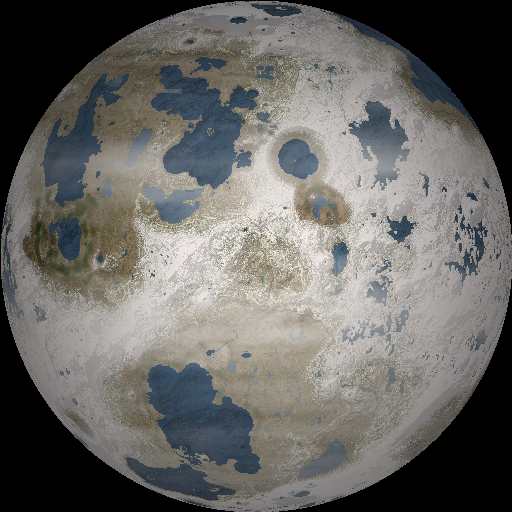
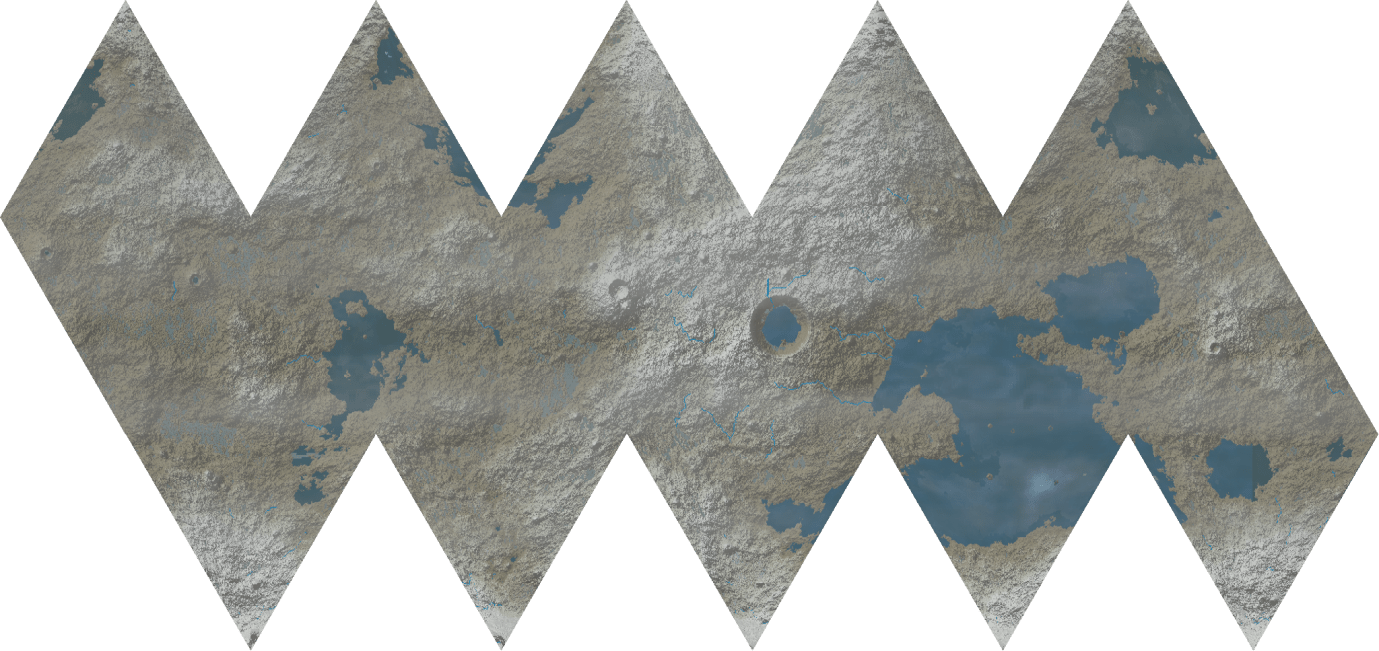
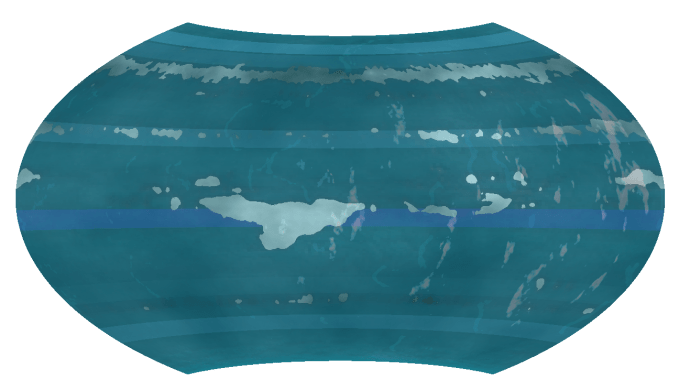
Pushpotayata


Mean Orbital Distance to Surya: 900 million km
Days to Orbit: 4,382
Mean Radius: 20,000 km
Surface Area: 5.03 billion km2, Landmass Unknown
Base Temperature: -10° C
Seasonal Variation: -1° C (High), -40° C (Low)
Average Annual Precipitation: Unknown
Significant Imports: None
Significant Exports: None

Mitra V (Pushpotayata) and VI (Kumbhinasi) are frost giants at the outer reach of the Surya system, believed to be currently uninhabited, although there are known Kravyad ruins and suspected Naval listening posts on Mitra V. Pushpotayata has a planetary ring system comprised mostly of frozen water, in addition to more exotic elements.

Pushpotayata

Radium Drive

Radium drives provide advanced vectored propulsion by applying a highly energetic power source (a pulsed akashic field) to a complex Alchemical compound (Radium, stabilized in isotopes I-XII). Coupled with an active Inertial Ward, this reaction creates directed kinetic energy (high thrust, high specific impulse) without combustion or expelling reaction mass as propellant (the radium compound is not consumed in the process). Acceleration at 10 to 30 meters per second squared is possible, but the comparatively “thirsty” option can deplete a powerplant in hours of operation, as opposed to the weeks of sustained Empyrean Sail use.

The process of charging and recharging the Radium compound does result in lessening efficiency over time, however. Radium X drives have useful half-lives on the order of 18 months.

Yami Belt Colony – Mahanadi

Mahanadi

QuadrantIII
BearingYamuna +33º 
Mean Orbital Distance:374 M km
Days to Orbit:1174
Mean Radius:397 km
Surface Area:1,980,000 km2
Base Temperature4.6° C
Seasonal Variation:15.4° C (High), -6.3° C (Low)
Average Precipitation8 cm
Significant Imports:Consumer Items, Organics
Significant Exports:Industrial Materials (Eco-tech), Metals (Precious Metals), Textiles

Notes

Authority:  Independent, Refinery Outpost

Yami Belt Colony – Yamuna

Yamuna – Quadrant III Capital

QuadrantIII
Mean Orbital Distance:368 M km
Days to Orbit:1202
Mean Radius:459 km
Surface Area:2,650,000 km2
Base Temperature3.9° C
Seasonal Variation:14.89° C (High), -7.02° C (Low)
Average Annual Precipitation27 cm
Significant Imports:Industrial Materials, Consumer Items, Organics
Significant Exports:None

Notes

Yami Belt Quadrant Capital

Authority: Provincial, Church

Significant colonies in the Yamuna Quadrant include

Yami Belt Colony – Gomati

Gomati

QuadrantI
Mean Orbital Distance:366 M km
Days to Orbit:1150
Mean Radius:508 km
Surface Area:3,240,000 km2
Base Temperature6.6° C
Seasonal Variation:19.2° C (High), -6.1° C (Low)
Average Annual Precipitation22 cm
Significant Imports:Minerals, Consumer Items, Organics
Significant Exports:Alchemicals (Fuels), Machinery (Energy-tech)

Notes

Authority: Outlaw, Refinery / Industrial Outpost

Raka

Mean Orbital Distance: 450 million km
Days to Orbit: 1,549
Mean Radius: 5,600 km
Surface Area: 394 million km2, Land 157 million km2
Base Temperature: 15.3° C
Seasonal Variation: -5 C / +2 C
Average Annual Precipitation: 75 cm
Significant Imports: Organics (4 MMT), Consumer Items (3 MMT)
Significant Exports: Minerals (12 MMT), Metals (6Mt)

Mitra III (Raka) is a military outpost of the Janya people and the Mitrakam Solar Kingdom. To the Kravyad , this world is Bante.

Empyrean Sails

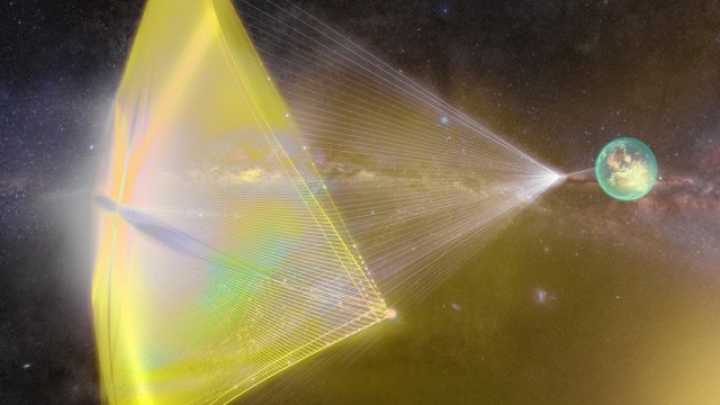
Magnetic “hoops” a kilometer or more in diameter are projected adjacent to spacecraft via magnetic projector, and the nearly sheer planes of particles within are ignited via an akashic powered plasma caster to form plasma constructs that interact with the shakti currents in solar space. These force planes known as “Empyrean Sails” can be manipulated and rotated much as a physical sail could be; perpendicular, parallel, or angled to the craft, Surya, or the direction of travel.

Sustained acceleration / deceleration upwards of 3 meters per second squared in addition to impressive maneuverability are possible under the hand of a skilled navigator. Due to the presence of dark matter in solar space, faster speeds are not practical regardless of the size of the vehicle, and the shakti currents dwindle to unusability at the heliopause of Surya.

Ground based installations constructed at the intersection of telluric shakti pathways focus and refine the energy to allow orbital launch and recovery operations with very little direct energy expenditure by the vessels involved. Breaking atmosphere at locations other than said installations occurs, but at a much higher energy cost (usually, via Radium drive). Identifying and harnessing said energy is a function of the Cleric caste, and on civilized worlds, metropolises usually exist at these telluric intersections. The less civilized the world (and less corresponding influence the Church wields), the less likely there is an infrastructure to take advantage of the opportunity.

Aruna  (Kaikasi b)

Aruna  (Kaikasi b)

Mean Orbital Distance: 0.45 million km from Kaikasi
Days to Orbit: 2
Mean Radius: 3,500 km
Surface Area: 154 million km2, Land 100 million km2
Base Temperature: 30° C
Seasonal Variation: -15° C / +6° C
Average Annual Precipitation: 50 cm
Significant Imports: Metals (7 MMT), Food (3 MMT)
Significant Exports: Machinery (6 MMT), Consumer Items (2 MMT)

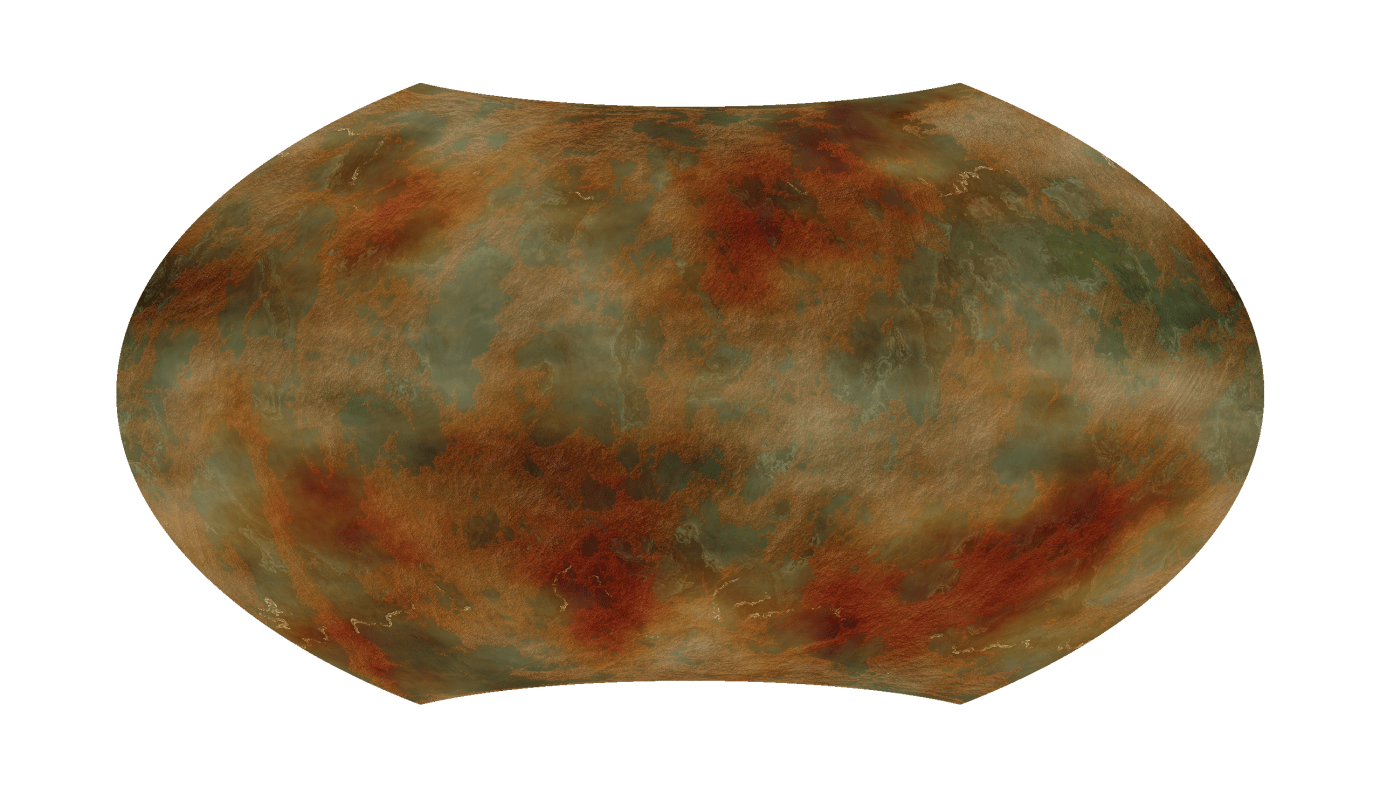
A dense world, rich in iron ore and red with rust. Aruna’s main industry is industrial production. To the Kravyad , this word is Dearg.

The Patron of Aruna is Rana Taws, the Peacock Angel. The central sanctuary of the Thearch of the Orthodox Church is located on this world.

Kaikasi Orbital Settlements

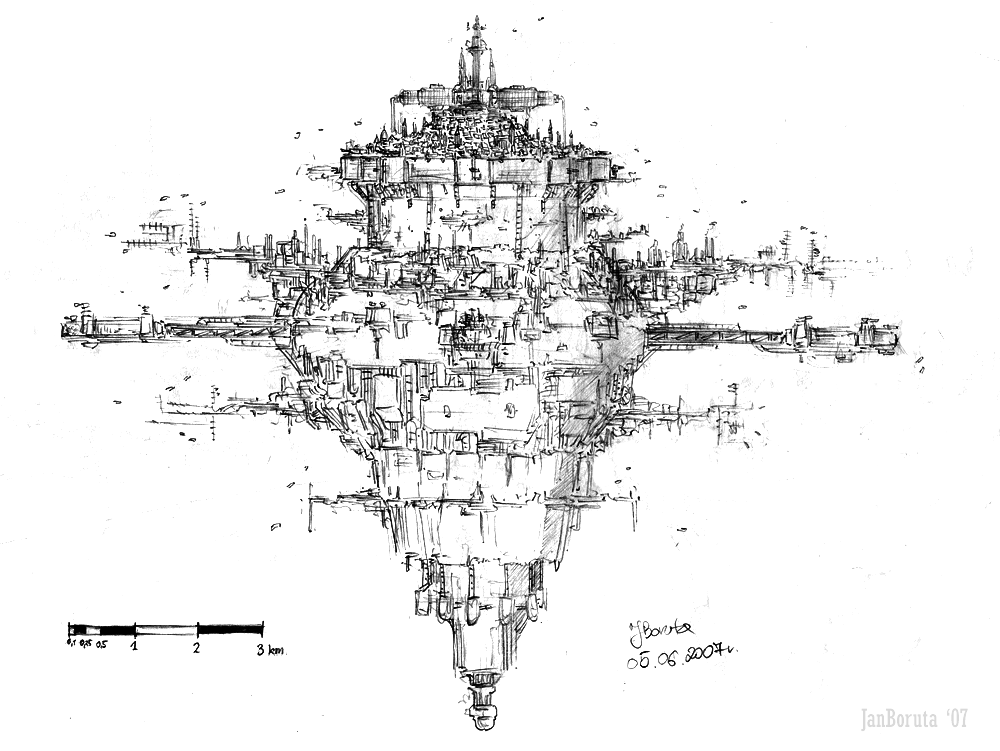
The Savant enclaves on Kaikasi are built out of the dvīpa (floating mountains) native to the storm giant, which orbit high above the crushing surface altitudes of the planet. The inhabited dvīpa are still moderate to high gravity environs, which suits Savant physiology as well as providing a variety of useful research and engineering environments. There are at least a few hundred enclaves, but thousands of (at least marginally) inhabitable dvīpa, massing from hundreds to thousands of cubic kilometers in volume.

Raksasa and the Janya Artisan caste are at a disadvantage in high gravity, although not as much of one as those of the Cleric or Nobility caste.