Yama

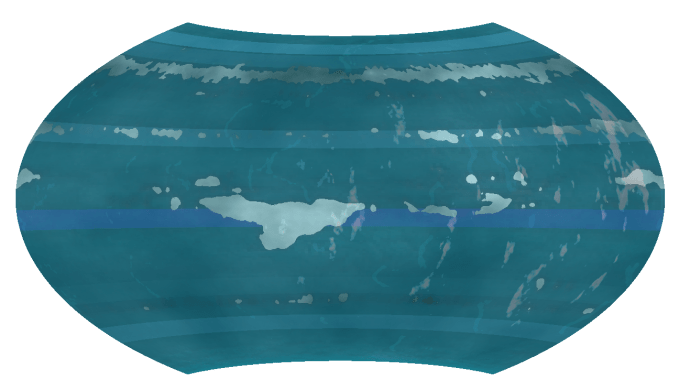
The Void Devils that periodically wreck so much havoc in the Solar Kingdoms are the natives of a world that orbits Mitra B, the brown dwarf co-binary companion to Surya (Mita A). These Abhva bring conflict and discord in the periods where Mitra A and Mitra B are close enough to transit (every 745 Local Years, for a 70 to 140-year period).

Due to the limitations of Empyrean Sails, as well as dark matter interference (among other things), the Janya lack precise astrometric data regarding the Yama system. There is at least one inhabited world in the system (“Planet X”), although presumably there may be more.

Technik and…Medicine

Elemental Technik and Vivacism have served to greatly extend Janya lifespans from a low of approximately 125 Local Years for the Artisan caste, to 230 Local Years and counting for those who can afford it, primarily the Nobility Caste. The practice of Janya advanced technik medicine is known as “Ayurveda”. There are three distinct branches of Ayurveda; those devoted to the Janya Artisan (and Outcaste) physiology, those devoted to the Janya Nobility (and Cleric) physiology, and those devoted to Savant Caste physiology. As each Caste does not lack for examples of brilliant intellect and education opportunity; physicians of every stripe are present in each Caste (and gender, as it happens), although there are cultural biases that advantage physicians of each Caste tending to their peers.

Kravyad medicine is a specialty somewhere between zoology and combat medicine, usually possessed as an additional skill set on top existing physician training.

Practically, Sādhanā allows for the regrowth of organs, prevention / remission of disease, and ameliorating the effects of age; while Technik allows for alchemical tonics, medicines, and treatments as well as the creation of biopolymer (q.v.) based prosthetics.

Fate Core

In addition to the background piece, and the story piece, there is a game mechanics piece where my jolly band of misfits and I resolve conflict and determine how chance interacts with the efforts of our protagonists. In the “tabletop role-playing game” context, I’m talking about the the game part.

We tried a few different systems before settling where we did. We looked at Slipstream, for the Savage Worlds system. We looked at Equinox / Match System. We actually tried out Rocket Age for a few sessions, but found there was a disconnect between the pulp excellence of the setting, and how effective the starting characters could be,

Which is where Fate Core (by Evil Hat Productions) comes in. Fate Core is definitely a lot more collaborative than the traditional RPG (as the gamemaster I have a plurality of discretion in the game, but not a majority), which was an is a pretty big adjustment for everyone involved. It’s also relatively setting agnostic, which means there are quite a few things tagged as “Extras” that pretty integral to *our* setting that we are left to work out the details ourselves (for better or worse, there are pretty frequent rules implementations that change how things work), such as technology, equipment, magic, wealth, and spaceships. As I said, some of the central set dressing of science-fiction.

But there is a sentence in the “What Makes a Good Fate Game” that a) really sold me on trying the system, and b) turns out to be practically true in a way that enables success to build upon itself. Specifically, “Whether you’re talking about fantasy, science fiction, superheroes, or gritty cop shows, Fate works best when you use it to tell stories about people who are proactive, competent, and dramatic.”

And that’s the state we aspire to.

Andhaka, Sramana, Siddha

All living being possess some amount of prana (life) and shakti (soul) energies (these are the primary subtle energies in Rockets and Mayhem). Healthy beings generate more of each of these than they absorb from the universe around them.

Among the Janya, those with sufficiently advanced capacities for shakti generation and retention are known as Śramaṇa. At this level, individuals are capable of influencing the material forms of matter and energy around them, as well as the subtle energies, at the subconscious level. This generally expresses itself in the form of extremely good luck and a facility with the advanced Janya science of Technik, the interaction of material and subtle forces.

The majority of Janya are Śramaṇa.

Those who lack this capability for shakti interactions are known as Andhaka. This manifests itself to the Janya as correspondingly (but not probabilistically[1]) bad luck, and doubt based gremlins that cause failures and mishaps when interacting with Technik constructs. Among the few positive benefits, Andhaka are resilient to the effects of Sādhanā to a surprising degree.

On the other hand, there are those (especially among the Savant and Cleric castes) who posses shakti capabilities an order of magnitude or more advanced than the Śramaṇa. These are the Siddha, Janya mystics who can interact with the material and subtle forces of the universe at a conscious level, requiring no physical constructs to do so. They can change the forms of matter, spontaneously generate bursts of energy, communicate physically over great distances, and stave off the entropic forces of the universe for a time.


[1] If a Śramaṇa flipped a coin one hundred times, they could predict the outcome seventy to seventy five percent of the time. When Andhaka attempt the same, their accuracy is closer to 50 percent. When the Andhaka do so in a contest with a Śramaṇa, they are only correct roughly one time in four.


The Space Between

Per the metaphysical truths at the heart of the setting (“there is a positive creative force in the universe, but there is a negative destructive one as well”), Worlds are hospitable places, granted the benefits of gravity, atmosphere, warmth, and water by the benevolent emanations of Uhuru Medhā (the unknowable deity).
Contrarily, the Akashic space between worlds is not simply the barren vacuum of space as we know it, but a place of cold, of darkness, of stasis. Newtonian principles apply, but the fundamental forces of the universe can be idiosyncratic. An object in motion in the darknese will eventually come to rest, as its motion is simply…eaten. Continuous propulsion is thus the order of the day.

The space between worlds is cold, dark, and the air pressure is very, very low. Without protective gear, people exposed to the dark of space can perish within minutes.
The conditions are similar to terrestrial extreme altitudes (8,000 meters above sea level; 380 millibars of pressure; -40°C). Dark Matter and Dark Energy intrusions from the Void are uncommon, but known.

Navigational Hazards
As previously discussed, the space between worlds is not empty. Hostile elemental forces
make this domain their home, as do a variety of hazardous life forms of the leviathan class. Even civilian ships possess some
weaponry; and are frequently quite judicious in the application of force, given that bright lights can attract dark horrors. In addition to weapons, in-system navigation is facilitated by regular trade lanes, and lighthouse outposts along the way to guide the way.

Sādhanā (Psychic Power)

In Rockets and Mayhem, magic is real. Generally, one in four sentients will be born with *some* ability to manipulate reality via will, and species specific paradigms for the ability exist. Among the Janya, the ability to create a supernatural effect without the assistance of Technik is known as Sādhanā. The ability of the Kravyad to do so is known as “Witchcraft”, although for the most part it seems to consist of simple psychic phenomena (similar, but distinct from the manipulation of Shakti). The Black Magic of the Abhva and the Makara, is generally known as “Nemesis”.

Janya Sādhanā concerns itself with the mastery of three forces. The first are Akashic, which are the material forms of matter and energy. Those who seek to master these forces are Elementalists. The second force is Prana, the subtle element that animates life. Those who seek to master these forces are Vivacists. The third, and final, force is Shakti, the subtle element that governs thought and consciousness. Those that seek to master this force are known as Spiritualists.

The primary Sādhanā techniques are mantra and yantra, word and pattern. Sādhanā, even of the Elementalist or Vivacist domains, is fueled by Shakti…only living creatures blessed with this gift may manipulate the Sādhanā forces (see Andhaka). Possibly due to this limitation, Elementalism and Vivacism are individual pursuits (two Siddha from these paths may not combine their efforts), while Spiritualism is very much a collaborative effort (the default Spiritualist effects grow exponentially more powerful when fueled by a congregation).

Season Three is in Pre-Production

Season Three will feature pirate corsairs out of the Free City of Hanuruha operating under letters of marquee and reprisal against the Abhva and Makara.

Minimally, a pair of Corvette class cruisers operating in the Belt during one of the regular void devil incursions. Captaincy for at least two primary characters, first officer slots for up to two more. Crews and operating expenses for the ships provided by the free peoples of the belt. Possibly social goals of roping independent Kravyad outposts in the Belt less than sanguine about the civilizing influence of the Janya into a military alliance.

TBD is what exactly is of sufficient value to be salvaged from incursions ships to make combat rewarding enough to justify the risk.

Pushpotayata


Mean Orbital Distance to Surya: 900 million km
Days to Orbit: 4,382
Mean Radius: 20,000 km
Surface Area: 5.03 billion km2, Landmass Unknown
Base Temperature: -10° C
Seasonal Variation: -1° C (High), -40° C (Low)
Average Annual Precipitation: Unknown
Significant Imports: None
Significant Exports: None

Mitra V (Pushpotayata) and VI (Kumbhinasi) are frost giants at the outer reach of the Surya system, believed to be currently uninhabited, although there are known Kravyad ruins and suspected Naval listening posts on Mitra V. Pushpotayata has a planetary ring system comprised mostly of frozen water, in addition to more exotic elements.

Pushpotayata

Episode Four, Session Four

Previously on Rockets and Mayhem:

In pursuit of a Black Band Warrant on Khawaja Majumder (Espionage, Larceny, Grand Theft), our heroes had tracked the fugitive to high orbit of an unnamed world in the Yami Belt, and driven the attacking Makara heavy fighters off, at the cost of their own vessel.

After escaping from their own rocket shortly before it was destroyed, our heroes spacewalk over to the damaged yet mostly intact rocket of their bounty, and make their way inside. A running gun brawl battle up and down the lower decks of the ship, from the engineering deck to the cargo bay. Q Proud Mary gets himself in a bit of trouble when the tempestuous Raksasa makes one (unarmed) charge into emplaced enemies too many, and it’s all his teammates can do to pull him back to the safety of the engineering deck.

Our heroes are barricaded within, with access to the life support and navigation systems of the ship, when the remaining band of mercenaries hired to protect Majumder press forward with a final assault courtesy of overwhelming numbers.

Fade to black.